
How to Register a Church in Kenya (2026): The Complete Legal Guide for Religious Organizations
Church registration in Kenya is a mandatory legal requirement for any religious institution that intends to operate lawfully, establish physical premises, open a bank account, receive donations, and conduct organized public worship. Understanding how to register a church in Kenya is essential for founders, pastors, and ministry leaders who want to build a legally recognized and sustainable religious organization.
The registration process is governed by the Societies Act (Cap. 108) and administered by the Registrar of Societies under the Office of the Attorney General. All applications are processed through the official eCitizen Societies Registration Portal, which ensures transparency, accountability, and centralized government oversight.
Without proper registration, a church is considered illegal and may be restricted from operating or even face enforcement action. This makes compliance not just important but absolutely necessary for long-term ministry continuity.
This guide provides a complete breakdown of how to register a church in Kenya, including legal frameworks, eligibility requirements, step-by-step procedures, required documents, timelines, compliance obligations, and common mistakes to avoid. It is designed to give you practical, actionable, and legally accurate insights to help ensure your church registration process is smooth, compliant, and successful from start to finish.
Legal Framework Governing Church Registration in Kenya
All churches and religious organizations in Kenya are registered as societies under the Societies Act (Cap. 108). The process is administered by the Registrar of Societies under the Office of the Attorney General, and applications are submitted through the official eCitizen Societies Registration Portal.
Under this legal framework:
- Registration is compulsory for all religious organizations operating in Kenya
- Running an unregistered church is considered a legal offence
- No church is allowed to conduct organized public worship without approval
- All applications must be processed through the government’s digital system
This legal structure ensures accountability, transparency, and proper governance of religious institutions across the country.
Eligibility Criteria for Registering a Church in Kenya
To understand how to register a church in Kenya, it is important to first meet the eligibility requirements. A church can be registered by:
- Founders or individuals establishing a new ministry
- A group of officials representing a religious organization
- Existing ministries formalizing their legal status under Kenyan law
Every church must have a leadership structure that includes:
- Chairperson
- Secretary
- Treasurer
Additional assistant officials may be included to strengthen governance, accountability, and administrative efficiency. These officials form the legal foundation of the church as a registered society.
Step-by-Step Process: How to Register a Church in Kenya
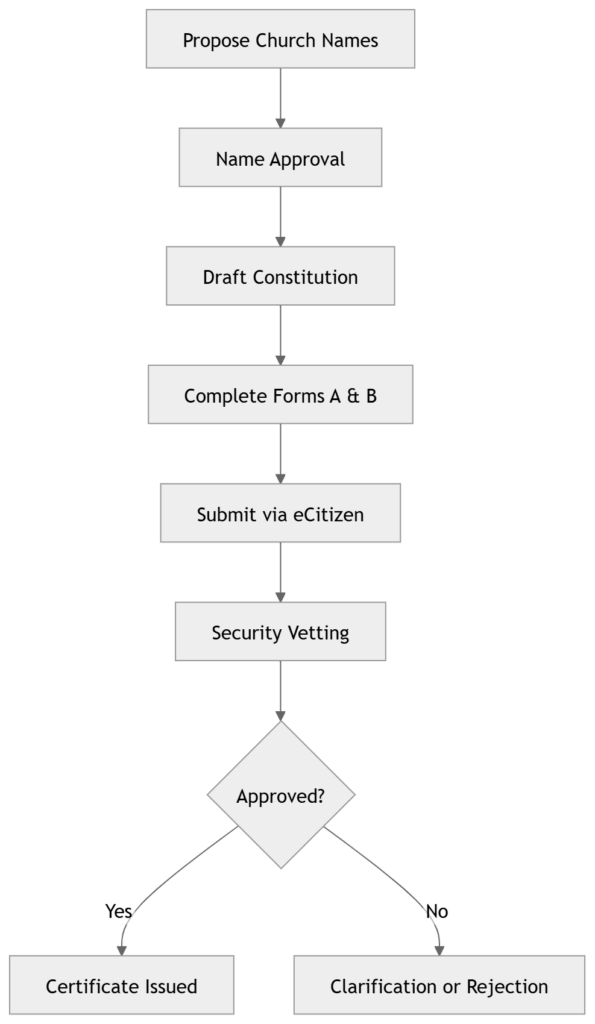
Step 1: Church Name Search and Reservation
The first step in how to register a church in Kenya is selecting a suitable name. Applicants are required to propose at least three unique names.
The Registrar of Societies reviews the names to ensure:
- The name is not identical or too similar to an existing society
- The name is not misleading, offensive, or restricted
- The name reflects a legitimate religious identity
Only after approval of one name can the registration process proceed.
Step 2: Drafting a Legally Compliant Church Constitution
A church constitution is one of the most important documents in the registration process. It defines how the church will operate and govern itself.
A strong constitution must clearly outline:
- The church’s mission, vision, and objectives
- Governance structure and leadership roles
- Membership requirements and admission procedures
- Duties and responsibilities of officials
- Financial management and accountability systems
- Procedures for meetings and decision-making
- Rules for dispute resolution and disciplinary action
- Conditions for dissolution of the church
The constitution must be signed by all founding officials to confirm agreement and legal commitment.
Step 3: Completion of Statutory Forms
Applicants must complete official government forms, including:
- Society Form A – Application for registration
- Society Form B – Notice of registered office
These documents must be accurately filled to avoid rejection or delays in processing.
Step 4: Submission via eCitizen Portal
All documents are submitted through the official eCitizen Societies Registration Portal. At this stage:
- All forms and supporting documents are uploaded digitally
- Government processing fees are paid online
- Application tracking begins
This step ensures centralized and transparent processing by the Registrar of Societies.
Step 5: Mandatory Security Vetting of Officials
Security vetting is one of the most critical stages in how to register a church in Kenya. Government agencies assess the background of all listed officials.
The vetting process typically takes 4–8 months, depending on:
- Number of church officials involved
- Accuracy and completeness of submitted information
- Location and accessibility of officials
- Consistency of identity and compliance documents
This stage ensures that church leadership meets integrity and security standards.
Step 6: Approval and Issuance of Certificate
Once vetting and review are successful:
- A Certificate of Registration is issued
- The church becomes a legally recognized religious entity in Kenya
- The church is authorized to operate officially
If issues arise, the Registrar may request clarification or reject the application.
Mandatory Requirements for Church Registration in Kenya
Applicants must provide detailed documentation, including:
- Full names and contacts of all officials
- National ID or passport copies
- KRA PIN certificates and tax compliance certificates
- Passport-size photographs
- Physical address of the church (plot, road, town, county)
- Theology qualification for at least one official
- Police Clearance Certificates (Good Conduct)
- Sworn affidavits declaring involvement in other societies
- Recommendation letter from a registered church
- Membership register with full details
- Minutes of the founding meeting
Incomplete documentation is the most common reason for delays and rejection.
Certificate of Exemption vs Full Registration
Full Registration
- Required for most new churches
- Requires compliance with annual reporting obligations
- Ensures full legal recognition
Exempt Society Status
- Granted at the discretion of the Registrar
- Usually reserved for large or established organizations
- Exempt from filing annual returns and financial reports
Church Registration Timeline in Kenya
Understanding timelines is important when learning how to register a church in Kenya:
- Name search and preparation: 2–4 weeks
- Document submission and initial review: 1–2 weeks
- Security vetting process: 4–8 months
Total Estimated Timeline: 5 to 9 months
Church Registration Workflow Diagram
Why Professional Assistance Is Important
Professional support improves success rates in church registration by ensuring:
- Proper legal drafting of constitutions
- Full compliance with the Societies Act
- Accurate documentation and submission
- Continuous follow-up with authorities
- Reduced delays and rejection risks
This significantly simplifies the process of how to register a church in Kenya.
Common Mistakes to Avoid
Many applications fail due to avoidable errors such as:
- Submitting incomplete documents
- Using names similar to existing churches
- Poorly structured constitutions
- Missing or incorrect vetting documents
- Inconsistent official details
Avoiding these mistakes improves approval chances significantly.
Post-Registration Compliance
After successful registration, churches must:
- File annual returns with the Registrar
- Maintain updated membership records
- Keep proper financial records
- Notify authorities of leadership or address changes
Failure to comply may lead to penalties or deregistration.
Benefits of Registering a Church in Kenya
- Full legal recognition and protection
- Ability to open bank accounts
- Ownership of property and assets
- Eligibility for donations and partnerships
- Improved credibility and trust
Frequently Asked Questions
1. Is church registration mandatory in Kenya?
Yes. All churches must be registered under the Societies Act.
2. How long does it take to register a church in Kenya?
The process takes approximately 5 to 9 months due to vetting requirements.
3. Can a church operate without registration?
No. Operating an unregistered church is illegal.
4. Why do church applications get rejected?
Common reasons include incomplete documents, failed vetting, or duplicate names.
5. Can foreigners register a church in Kenya?
Yes, provided they meet all legal and documentation requirements.
How to Register a Church in Kenya
Understanding how to register a church in Kenya is a crucial step for any individual or group seeking to establish a legally recognized religious organization. The registration process is not only a legal requirement but also a foundation for building trust, credibility, and long-term sustainability within the Kenyan religious and legal system.
A properly registered church gains the ability to operate without legal interruptions, own property, open official bank accounts, receive donations transparently, and engage in structured community outreach. More importantly, it ensures compliance with the Societies Act (Cap. 108), which governs all religious institutions in Kenya under the supervision of the Registrar of Societies.
While the process may appear complex due to documentation requirements and mandatory security vetting, proper preparation significantly increases approval success rates. Every step—from name reservation, constitution drafting, submission of forms, to final approval—must be handled with accuracy and attention to detail to avoid delays or rejection.
Ultimately, successful church registration in Kenya provides more than legal approval; it establishes legitimacy, organizational structure, and institutional stability. For ministries and founders committed to long-term impact, understanding and correctly executing how to register a church in Kenya is an essential foundation for growth, governance, and lawful operation within the country’s regulatory framework.