
How to Change Your Birth Certificate Name | Changing Names on Birth Certificates in Kenya
Changing a name on a birth certificate in Kenya is one of the most sensitive legal and administrative processes affecting a child’s identity. Many parents discover mistakes in names after registration, while others later decide to add, remove, or correct names due to cultural, personal, religious, or family reasons. In other situations, hospital records may contain spelling errors, incorrect surnames, or parent details that do not reflect the family’s final decision. Unfortunately, many parents receive inconsistent information from hospitals, Huduma Centres, and even Civil Registry offices, leading to confusion, delays, and unnecessary frustration.
Understanding how to change your birth certificate name in Kenya is extremely important because a birth certificate is not just a document for identification. It is the foundation of a child’s legal identity and affects school registration, KCPE and KCSE examinations, passport applications, immigration records, inheritance rights, healthcare access, and future national identification processes. A mistake on this document can later create serious complications if not corrected early and properly.
At AWK Advocates, we understand the legal and practical challenges parents face when handling birth certificate amendments in Kenya. This detailed guide explains everything you need to know about how to change your birth certificate name, including legal procedures, timelines, deed poll requirements, surname rules, late registration, correction of parent details, and the official amendment process through Civil Registration Services and eCitizen. Whether you are correcting a spelling mistake, changing a surname, removing a parent’s name, or handling late registration, this guide provides a complete legal roadmap to help you navigate the process confidently and lawfully.
Understanding Birth Notification vs Birth Certificate in Kenya
Many parents mistakenly assume that a birth notification and a birth certificate are the same document. In reality, Kenyan law treats these documents very differently, and understanding the distinction is essential when learning how to change your birth certificate name.
A birth notification is only the first administrative step after birth, while a birth certificate becomes the final legal proof of identity after registration is completed by the Civil Registrar.
What Is a Birth Notification?
A birth notification is a preliminary record issued immediately after a child is born. It is normally generated by:
- Hospitals
- Clinics
- Health facilities
- Maternity centers
- Authorized birth attendants
Its main purpose is to notify the Kenyan Civil Registration Department that a child has been born. It is not the final legal identity document of the child.
The notification generally contains:
- Temporary or preliminary child names
- Date of birth
- Place of birth
- Parent information
- Gender
- Birth serial details
Many parents panic after noticing spelling mistakes or incorrect surnames on the notification. However, this document does not permanently determine the child’s official legal name.
The hospital merely records information provided at the time of birth. Hospitals do not possess legal authority to finalize parentage, surnames, or official names. That authority belongs to the Civil Registrar during formal registration.
This distinction is critical because many parents wrongly believe that once a hospital enters a name, it can never be changed. Kenyan law does not support that assumption.
What Is a Birth Certificate?
A birth certificate is the official government-issued legal document generated after successful registration in the national Birth Register.
Unlike a birth notification, the birth certificate becomes the child’s legally recognized identity document.
The birth certificate officially proves:
- Identity
- Citizenship
- Nationality
- Parentage
- Date of birth
- Place of birth
This document becomes extremely important throughout the child’s life because it is required for:
- School admission
- KCPE registration
- KCSE registration
- Passport applications
- National ID processing
- Visa applications
- NHIF registration
- NSSF services
- Immigration documentation
- Succession and inheritance matters
- Banking procedures
- Government services
Errors on this document can create future legal complications. That is why understanding how to change your birth certificate name properly is extremely important for every parent or guardian in Kenya.
Can You Change a Child’s Name Before the Birth Certificate Is Issued?
Yes.
Under Kenyan administrative procedures, parents are legally allowed to change, correct, or modify a child’s name before the birth certificate is formally issued.
This means parents may:
- Correct spelling mistakes
- Add missing names
- Remove unwanted names
- Change surnames
- Rearrange names
- Replace temporary hospital names
Many parents first register temporary names at the hospital due to pressure, medical emergencies, cultural discussions, or family disagreements. Later, after consultations with relatives or religious leaders, they may decide to adopt different names entirely.
Kenyan law recognizes this reality and allows flexibility before final registration.
As long as the birth certificate has not yet been officially generated, the registrar may record the final chosen names without treating the changes as formal amendments.
This is one of the most important legal protections available to parents during birth registration.
Legal Rules on Choosing a Child’s Name in Kenya
Kenyan law grants parents and legal guardians broad discretion when selecting a child’s name during first registration.
A child’s registered name may legally include:
- Multiple first names
- Christian names
- Islamic names
- Traditional names
- Family names
- Clan names
- Maternal surnames
- Paternal surnames
There is no law forcing parents to adopt the hospital notification name as the final legal name.
Similarly, there is no mandatory legal requirement that every child must use the father’s surname.
Parents retain freedom to determine the child’s legal identity within lawful administrative standards.
The registrar’s responsibility is mainly to ensure:
- Names are properly recorded
- Fraud is prevented
- Parentage requirements are satisfied
- Supporting documents are valid
Understanding these rules is essential when researching how to change your birth certificate name because many disputes arise from misinformation rather than actual legal restrictions.
Using the Mother’s Surname on a Birth Certificate
One of the most misunderstood issues in Kenya involves the use of maternal surnames on birth certificates.
Legally, a child may use:
- The mother’s surname
- The father’s surname
- A blended family surname
- Another lawful surname selected during registration
Where parents are unmarried and the father has not legally acknowledged paternity, there is no obligation to register the child under the father’s surname.
This becomes especially important in situations involving:
- Single parenting
- Separation disputes
- Abandonment
- Paternity disputes
- Cultural considerations
- Safety concerns
Many registrars sometimes create confusion by implying that every child must automatically carry the father’s surname. Kenyan law does not impose such a requirement.
The key issue is whether legal recognition of parentage has occurred.
Inclusion of the Father’s Name on a Kenyan Birth Certificate
The father’s name is not automatically included simply because it appears on hospital records or birth notifications.
The Civil Registrar must satisfy legal requirements before officially recognizing paternity on the birth certificate.
When the Father’s Name Can Be Included
The registrar commonly requires one or more of the following:
- Marriage certificate
- Joint registration request
- Written consent
- Joint appearance before the registrar
- Formal acknowledgment of paternity
Where parents cooperate and supporting documents are available, inclusion of the father’s details is usually straightforward.
When the Registrar May Omit the Father’s Name
The registrar may lawfully decline to include the father’s details where:
- Parents are unmarried
- Consent is absent
- Paternity is disputed
- Legal requirements are incomplete
- Fraud concerns arise
This area often causes major disputes because many parents believe hospital forms alone determine legal parentage.
In reality, the Civil Registration process independently verifies whether the father’s details can legally appear on the birth certificate.
Timeline for Birth Registration in Kenya
Kenyan law encourages parents to register births promptly after delivery.
Early registration simplifies the process and minimizes administrative complications.
Registration Within Six Months
Birth registration within six months is considered standard registration.
During this period:
- Processing is easier
- Fewer supporting documents are required
- Verification is simpler
- Administrative approval is faster
Parents are strongly encouraged to complete registration early because delays later trigger stricter scrutiny.
Unfortunately, many families postpone registration due to financial difficulties, relocation, family disputes, or lack of awareness.
Late Birth Registration in Kenya
Any registration occurring after six months is categorized as late registration.
Late registration remains legal in Kenya, but additional verification measures apply because the registrar must confirm the authenticity of the birth information.
Reasons Late Registration Happens
Late registration may happen because of:
- Lost birth notifications
- Home births
- Family disagreements
- Missing parent identification documents
- Distance from registration offices
- Lack of awareness
- Financial hardship
- Delayed parental acknowledgment
- Religious or cultural naming delays
In rural areas especially, many parents only realize the importance of birth certificates when children begin school.
Requirements for Late Birth Registration in Kenya
Late registration applications usually require additional supporting evidence.
The registrar may request:
- Original birth notification
- Clinic cards
- Immunization records
- Baptism certificates
- School records
- Parents’ ID cards
- Guardian identification
- Affidavits
- Recommendation letters
- Chief’s letters
The purpose of these documents is to confirm that:
- The child exists
- The birth actually occurred
- Parentage claims are accurate
- Identity fraud is prevented
Each application is assessed individually depending on the available documentation and surrounding circumstances.
Birth Certificate Name Change After Issuance in Kenya
Once a birth certificate has already been issued, changing the child’s name becomes a formal amendment process.
This process depends heavily on:
- The child’s age
- How long ago registration occurred
- The type of correction required
- Whether parent details are affected
- Whether fraud concerns arise
The longer the delay after issuance, the stricter the amendment requirements usually become.
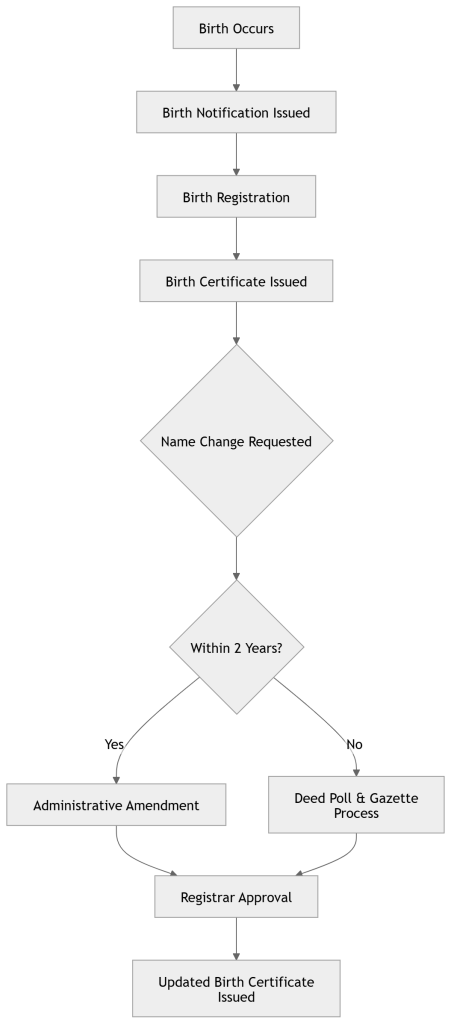
Name Change Within Two Years After Registration
Where the amendment request is made within two years after registration, the process is usually simpler.
In many cases:
- Administrative amendments are allowed
- A deed poll may not be required
- Registrar approval may be sufficient
This flexibility exists because the child is still very young and public records are less established.
Common Changes Allowed
Within the first two years, common amendments include:
- Spelling corrections
- Addition of names
- Removal of names
- Surname corrections
- Rearrangement of names
- Correction of typing errors
Parents often discover these issues during:
- Passport applications
- School registration
- NHIF processing
- Immigration procedures
Correcting errors early prevents larger complications later.
Documents Commonly Required
The registrar may require:
- Original birth certificate
- Parents’ identification cards
- Affidavit explaining the amendment
- Application forms
- Supporting evidence
- Child clinic records
The registrar retains discretion to request additional proof where inconsistencies appear.
Name Change After Two Years in Kenya
Once two years have passed after registration, the amendment process becomes more formal and legally sensitive.
At this stage, the registrar may require:
- Deed poll documentation
- Kenya Gazette publication
- Sworn affidavits
- Additional verification
- Court orders in disputed matters
The stricter process helps preserve integrity and reliability within Kenya’s public registration system.
Understanding Deed Poll in Kenya
A deed poll is a legal document formally declaring abandonment of an old name and adoption of a new one.
It becomes particularly important where:
- Major name changes are involved
- A child has grown older
- Public records already exist under the old name
- School records must be updated
- Government databases require consistency
The deed poll process often includes gazettement in the Kenya Gazette to formally notify the public of the change.
This procedure helps reduce identity fraud and protects legal records.
Process Flow for Birth Certificate Name Change in Kenya
Correcting Parent Details on a Birth Certificate
Correction or removal of parent information is treated seriously because it directly affects inheritance rights, citizenship claims, and legal identity.
The registrar carefully evaluates all requests involving parent details.
Situations That May Require Correction
Corrections may become necessary due to:
- Spelling mistakes
- Incorrect ID numbers
- Wrong surnames
- Disputed paternity
- Clerical errors
- Missing parent details
- Fraudulent registration concerns
Some cases may proceed smoothly administratively, while others may require court intervention.
Documents That May Be Required
Depending on the circumstances, the registrar may request:
- Parent identification documents
- DNA test results
- Court orders
- Affidavits
- Marriage certificates
- Consent letters
- Supporting records
The seriousness of the correction determines the level of scrutiny applied.
Applying Through eCitizen in Kenya
Kenya’s eCitizen platform has significantly modernized birth registration and amendment processes.
Applications may now be initiated online for:
- First-time birth certificates
- Duplicate certificates
- Amendments
- Corrections
- Late registration
After online submission, applicants usually appear physically at:
- Huduma Centres
- Civil Registration offices
- County registrar offices
for identity verification and document processing.
Although digital systems have improved efficiency, registrars still retain discretion to request additional documentation where necessary.
Common Mistakes Parents Make During Birth Registration
Many legal complications arise from avoidable mistakes during the registration process.
Understanding these mistakes can help parents avoid future amendment procedures.
Assuming Hospital Records Are Final
Hospital notifications are not legally final identity documents.
Parents should carefully review all details before formal registration.
Delaying Registration
Late registration creates unnecessary complications and increases documentation requirements.
Timely registration protects the child’s legal interests.
Using Incorrect Parent Information
False or inaccurate declarations may later trigger:
- Passport complications
- Immigration disputes
- Succession conflicts
- Court proceedings
Accuracy is extremely important.
Ignoring Minor Spelling Errors
Even a small spelling inconsistency may later affect:
- National ID processing
- Academic records
- Visa applications
- International travel
- Employment documentation
Parents should correct mistakes as early as possible.
Common Myths About How to Change Your Birth Certificate Name
Misinformation remains one of the biggest obstacles parents face when handling birth certificate amendments.
Myth 1: The Hospital Name Cannot Be Changed
False.
The hospital notification does not permanently determine the child’s legal name.
Parents may legally register different names before certificate issuance.
Myth 2: The Father Must Always Appear on the Certificate
False.
Inclusion of the father’s details depends on legal recognition requirements being satisfied.
Myth 3: Name Changes Are Impossible After Registration
False.
Kenyan law allows amendments through administrative procedures, deed polls, and other lawful mechanisms.
Myth 4: Late Registration Is Illegal
False.
Late registration remains lawful if sufficient supporting documentation is provided.
Frequently Asked Questions About How to Change Your Birth Certificate Name
Can I Add a Middle Name Later?
Yes.
Additional names may be added through formal amendment procedures.
Can a Child Have Multiple Names?
Yes.
Kenyan law permits multiple first names and middle names.
Can I Remove a Father’s Name?
Possibly.
Depending on the circumstances, the registrar may require:
- Consent
- Supporting evidence
- Court orders
- DNA verification
Disputed parentage matters often require additional legal review.
How Long Does the Amendment Process Take?
Timelines vary depending on:
- County office workload
- Complexity of the amendment
- Availability of supporting documents
- Whether gazettement is required
Simple administrative corrections may be resolved faster than deed poll matters.
Is a Court Order Always Necessary?
No.
Many name corrections are handled administratively through Civil Registration Services without litigation.
However, disputed matters involving parentage or fraud may require judicial intervention.
Why Accurate Birth Registration Matters
A birth certificate forms the legal foundation of a child’s identity throughout life.
Errors or inconsistencies can later affect:
- Education access
- Employment opportunities
- International travel
- Succession rights
- Banking services
- Government benefits
- Immigration records
Correct registration protects children from future legal complications and administrative barriers.
Key Takeaways on How to Change Your Birth Certificate Name
- A birth notification is not the final legal document
- Parents may choose different names during registration
- Birth registration should ideally occur within six months
- Late registration remains lawful but requires additional proof
- Name changes within two years are generally simpler
- Amendments after two years may require deed poll and gazettement
- Father details require lawful recognition procedures
- eCitizen has simplified the amendment process in Kenya
- Early correction of mistakes prevents future legal disputes
- Professional legal guidance may help avoid unnecessary delays
How to Change Your Birth Certificate Name
Understanding how to change your birth certificate name in Kenya is essential for protecting a child’s legal identity and future rights. Many parents only discover mistakes after school registration, passport applications, or immigration procedures begin, and by that time, the correction process may already have become more complicated. Acting early and understanding the legal framework helps families avoid unnecessary stress, delays, and administrative disputes with Civil Registration authorities.
The Kenyan legal system allows lawful correction and amendment of names on birth certificates through administrative procedures, registrar approvals, deed polls, gazettement, and court intervention where necessary. However, the success of any amendment process largely depends on proper documentation, timely action, and compliance with Civil Registration requirements. Whether the issue involves correcting spelling errors, changing surnames, removing a parent’s details, or handling late birth registration, understanding the correct legal process is critical.
At AWK Advocates, we assist parents and guardians in navigating the legal procedures surrounding birth registration, name amendments, late registration, deed polls, and correction of parent details in Kenya. Our goal is to ensure that children’s legal identities are properly secured while helping families avoid costly mistakes and unnecessary delays.
A properly registered and corrected birth certificate is more than just paperwork. It is the legal foundation upon which a child’s education, citizenship rights, travel documents, inheritance rights, and future opportunities are built.