
Cost of land succession in Kenya | Procedure of Land succession in Kenya
Complete Guide to Succession Process, Legal Fees, Timeline, Court Procedure, and Buying Succession Land in Kenya
Understanding the cost of land succession in Kenya requires a deep and detailed look at the entire succession process, the legal requirements involved, the court procedure, advocate fees, valuation costs, government charges, and the time required to complete inheritance cases. Many people only consider the filing fees when thinking about succession, but in reality the total cost of succession in Kenya is made up of several stages such as obtaining letters of administration, publishing the gazette notice, valuing the land, applying for confirmation of grant, transferring the title deed, paying registry charges, and in some cases handling court disputes between beneficiaries.
In most land inheritance cases, the final cost depends on the value of the property, the number of beneficiaries, the location of the land, and whether the family agrees on distribution. If there are disagreements, missing documents, or multiple parcels of land, the succession process becomes longer and the total cost increases significantly.
In this comprehensive guide, we explain in detail the cost of succession in Kenya, the succession process in Kenya, how long succession takes in Kenya, how to file a land case in Kenya, the legal requirements for inheritance, and the risks involved in buying succession land in Kenya, so that you have complete authority and understanding of the topic.
Understanding Land Succession in Kenya
Land succession in Kenya refers to the legal process through which ownership of land belonging to a deceased person is transferred to the rightful beneficiaries through the court. This process is governed by the Law of Succession Act Cap 160, which provides the legal framework that must be followed before any property of a deceased person can be shared, sold, or transferred.
When a person dies leaving land, the title deed cannot be changed directly to the name of the spouse, children, or relatives. The law requires that a succession case must first be filed in court so that the court can confirm who the legal beneficiaries are and who will be responsible for administering the estate. The court appoints an administrator or executor who is given authority to manage the estate until the distribution is completed.
There are two types of succession in Kenya. Testate succession happens when the deceased left a valid will explaining how the land should be shared. Intestate succession happens when the deceased did not leave a will. Intestate succession is more common in Kenya and usually takes longer because the court must determine the rightful beneficiaries according to the law.
Land succession becomes more expensive when there are many beneficiaries, when the land is located in different counties, when the title deed has problems, when the land is not registered properly, or when family members disagree about how the land should be divided.
The Succession Process in Kenya (Step-by-Step Explanation)
The succession process in Kenya follows a strict legal procedure that must be completed before land can be transferred to beneficiaries. Each stage must be approved by the court, and skipping any step may make the transfer invalid.
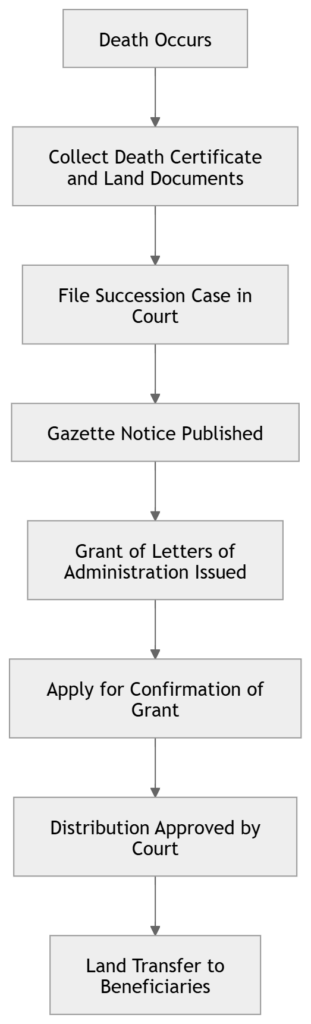
The process begins by collecting important documents such as the death certificate, title deed, identity cards of beneficiaries, and a letter from the chief confirming the family members of the deceased. These documents are required before filing the succession case in court.
After the case is filed, the court orders a gazette notice to be published so that anyone with an objection can come forward. This notice is required by law and must remain open for a specific period before the court can issue the grant.
If no objection is raised, the court issues a grant of letters of administration, which gives the administrator legal authority to manage the estate. After this, the administrator must apply for confirmation of grant, where the court approves how the land will be shared among the beneficiaries.
Once the grant is confirmed, the administrator can proceed to the land registry to transfer the land to the beneficiaries. Each of these stages has its own cost, which is why the total cost of land succession in Kenya can vary depending on the complexity of the case.
Cost of Land Succession in Kenya (Detailed Breakdown)
The cost of succession in Kenya depends on several factors including the value of the land, the number of beneficiaries, whether the case is contested, and the professional fees charged by advocates and valuers. The following table shows a realistic estimate based on current court practice in Kenya.
| Cost Item | Explanation | Estimated Cost (KES) |
|---|---|---|
| Court filing fees | Paid when opening succession case in court | 3,000 – 15,000 |
| Gazette notice fee | Mandatory government publication | 2,500 – 5,000 |
| Advocate legal fees | Drafting documents, filing, court attendance | 40,000 – 500,000+ |
| Land valuation fees | Required before confirmation of grant | 10,000 – 50,000 |
| Search and registry fees | Land search and registry documents | 2,000 – 20,000 |
| Confirmation of grant fees | Court approval of distribution | 2,000 – 10,000 |
| Land transfer fees | Paid during title transfer | 5,000 – 50,000 |
| Administration expenses | Managing estate before distribution | 10,000 – 100,000 |
| Dispute case costs | If court dispute arises | 100,000 – 1,000,000+ |
In simple succession cases the total cost may be below 50,000, but in complicated land succession cases involving large property, multiple parcels, or disputes, the cost may exceed 500,000.
How Long Does Succession Take in Kenya
Many people ask how long succession takes in Kenya, especially when land cannot be sold or transferred until the process is completed. The time required depends on how fast documents are prepared, whether beneficiaries agree, and how busy the court is.
In simple cases where all beneficiaries agree and documents are complete, succession may take between four months and eight months. However, most land succession cases take longer because documents are missing, some beneficiaries live far away, or someone raises an objection.
| Type of Case | Estimated Time |
|---|---|
| Simple uncontested succession | 4 – 8 months |
| Normal land succession case | 8 – 18 months |
| Complex estate with many assets | 1 – 3 years |
| Disputed succession case | 2 – 5 years |
The longer the case takes, the higher the cost becomes because advocates charge for additional work and more court appearances.
Buying Succession Land in Kenya (Risks and Legal Requirements)
Many people search about buying succession land in Kenya because land belonging to a deceased person is sometimes sold before the succession process is completed. This is very risky and can lead to loss of money or cancellation of the transaction.
According to the law, land belonging to a deceased person cannot be sold until the court confirms the grant and the land is transferred to the beneficiaries. Even if the family agrees, the sale is not valid without court approval.
Before buying succession land, it is important to confirm that the seller has a confirmed grant and that the land has already been transferred from the deceased to the beneficiary. A land search should always be conducted to verify ownership.
Buying land before succession is completed may result in court cases, cancellation of title, or loss of the land, which is why legal advice is always recommended.
How To File a Land Case in Kenya During Succession
Disputes may arise during succession when beneficiaries disagree about how the land should be shared. In such situations, a land case may be filed in court to resolve the disagreement.
A land case may be filed in the High Court, Magistrates Court, or Environment and Land Court depending on the issue. The person filing the case must prepare legal documents, pay court fees, and provide evidence showing why the distribution is unfair or illegal.

When a dispute is filed, the succession process becomes longer and more expensive because the court must hear all parties before making a decision. Advocate fees also increase because the case requires more time and preparation.
Land cases during succession usually happen when there is fraud, hidden land, forged signatures, or disagreement among family members.
Advocate Fees for Land Succession in Kenya
Legal fees form the largest part of the cost of land succession in Kenya. Advocates charge depending on the value of the land, the complexity of the estate, and the amount of work involved.
Small estates cost less because the work is simple, but large estates require more documents, more court appearances, and more time to complete.
| Estate Value | Legal Fee Range |
|---|---|
| Below 500,000 | 30,000 – 80,000 |
| 500k – 5M | 80,000 – 200,000 |
| 5M – 20M | 200,000 – 500,000 |
| Above 20M | Negotiable |
Legal fees also increase when there are objections or disputes between beneficiaries.
How to Reduce the Cost of Succession in Kenya
The cost of land succession can be reduced when the process is handled correctly from the beginning. Preparing a valid will helps the court follow the wishes of the deceased without delay. Keeping proper land documents also prevents problems during filing.
Families should agree on distribution before filing the case because disputes make the process expensive. Filing succession early is also important because waiting for many years may cause documents to be lost or beneficiaries to disagree.
Using one advocate instead of many lawyers helps control the cost and keeps the process organized.
Why Land Succession Cases Become Expensive in Kenya
Succession cases become expensive when the estate has many beneficiaries, when land is located in different places, when documents are missing, or when family members disagree about inheritance.
Costs also increase when land is sold before succession is completed, because this often leads to court cases and additional legal fees.
Proper legal guidance from the beginning helps avoid delays and reduces the total cost of succession.
Professional Help With Land Succession in Kenya
We handle land succession cases across all counties in Kenya, including Nairobi, Kiambu, Thika, Juja, Ruiru, Machakos, Nakuru, Eldoret, Meru, Nyeri, Mombasa and all over Kenya. Our services include filing succession cases, handling inheritance disputes, transferring land after death, and advising clients buying land under succession.
We ensure the succession process is completed correctly, within the law, and at the lowest possible cost while protecting the rights of all beneficiaries.
Documents Required for Land Succession in Kenya
Before starting a succession case, the court requires specific documents to confirm the identity of the deceased, the beneficiaries, and the property involved. Missing documents are one of the main reasons why succession cases delay and become expensive. Preparing the correct documents in advance helps reduce both the time and the cost of land succession in Kenya.
The most commonly required documents include the death certificate of the deceased, the original title deed or land ownership documents, identity cards and PIN certificates of the beneficiaries, and a letter from the local chief confirming the family members of the deceased. The chief’s letter is important because the court relies on it to identify the rightful beneficiaries before issuing the grant.
In addition to these documents, the court may require marriage certificates, birth certificates, land search records, and any written agreement showing how the family intends to share the land. If the deceased left a will, the original will must also be presented in court before the succession case can proceed.
Failure to provide these documents may cause the court to reject the application or delay the process, which increases the total cost of succession.
Letters of Administration in Kenya and Their Cost
One of the most important stages in the succession process is obtaining letters of administration, which is the legal document issued by the court allowing a person to manage the estate of the deceased. Without this document, no one has the authority to transfer land, withdraw money from bank accounts, or sell property belonging to the deceased.
To obtain letters of administration, a petition must be filed in court together with supporting documents. After filing, the court requires a gazette notice to be published to allow anyone with an objection to come forward. If no objection is raised, the court issues the grant.
The cost of obtaining letters of administration includes court filing fees, gazette notice fees, advocate fees, and document preparation costs. In most cases, the total cost for this stage ranges between 10,000 and 100,000 depending on the complexity of the estate.
When the estate has many beneficiaries or large land parcels, the cost becomes higher because more documents and court appearances are required.
Confirmation of Grant and Land Distribution Costs
After the grant of letters of administration is issued, the administrator must apply for confirmation of grant. This stage is necessary because the court must approve how the land will be shared among the beneficiaries before any transfer can take place.
During confirmation of grant, the administrator presents a list showing all the land owned by the deceased and how it will be divided. All beneficiaries must agree with the distribution, and if anyone objects, the court may require a hearing before making a decision.
The cost of confirmation of grant includes court fees, advocate fees, and in some cases valuation fees if the court requires the value of the land to be confirmed. If the land is large or located in different counties, additional costs may arise because separate searches and documents may be needed.
Once the grant is confirmed, the administrator can proceed with the transfer of land to the beneficiaries at the land registry.
Land Transfer After Succession in Kenya
After the court confirms the grant, the final stage is transferring the land from the name of the deceased to the beneficiaries. This process is done at the land registry and requires official documents from the court showing that the succession case has been completed.
Land transfer after succession involves paying transfer fees, stamp duty in some cases, land registry charges, and document processing fees. The amount paid depends on the value of the land and the number of beneficiaries receiving shares.
If the land is being subdivided among several beneficiaries, additional survey costs may be required. Survey fees, mutation forms, and registry approvals may increase the total cost of succession, especially when the land must be divided into many portions.
This is one of the reasons why the cost of land succession in Kenya is not fixed and can vary from one case to another.
What Happens If Succession Is Not Done in Kenya
Many families delay succession for many years after the death of a land owner. This often leads to serious problems such as disputes between children, illegal sale of land, or loss of documents.
When succession is not done, the land legally remains in the name of the deceased, and it cannot be sold, transferred, or used as security for a loan. Any sale done without succession may later be cancelled by the court.
Delaying succession also increases the cost because documents may be lost, beneficiaries may die, and new disputes may arise. In some cases, the court may require additional evidence to confirm the rightful heirs, which makes the process longer and more expensive.
For this reason, it is always recommended to start succession as soon as possible after the death of the land owner.
Common Mistakes That Increase the Cost of Land Succession in Kenya
One of the biggest reasons why succession becomes expensive is mistakes made at the beginning of the process. Many families try to handle succession without proper legal advice, which often leads to errors that must be corrected later in court.
A common mistake is selling land before succession is completed. This usually leads to disputes and court cases, which increase the cost significantly. Another mistake is failing to include all beneficiaries in the application, which may cause the court to cancel the grant.
Some people also file succession in the wrong court, especially when the value of the estate is higher than the court’s limit. When this happens, the case must be transferred, causing delays and additional fees.
Missing documents, wrong names, and disagreements among family members are also common causes of increased succession costs.
Handling the process correctly from the beginning helps reduce both the time and the cost of succession.
Choosing the Right Succession Lawyer in Kenya
Because succession involves court procedure, land law, and family law, it is important to work with a lawyer who understands inheritance cases. A qualified succession lawyer helps prepare the documents correctly, file the case in the right court, and avoid mistakes that may cause delays.
The cost of hiring a lawyer may seem high at first, but in most cases it saves money because the case is completed faster and without errors. A good lawyer also helps resolve disputes before they reach court, which reduces the total cost of succession.
When choosing a succession lawyer, it is important to consider experience, knowledge of land matters, and ability to handle court cases. Succession cases involving land require careful handling because mistakes may affect ownership permanently.
Total Cost of Land Succession in Kenya
The cost of land succession in Kenya depends on many factors including the value of the land, the number of beneficiaries, the complexity of the estate, and whether disputes arise during the process. While simple cases may cost less than fifty thousand shillings, complex cases involving large land or disagreements may cost hundreds of thousands.
Understanding the succession process, preparing the correct documents, and seeking legal advice early helps reduce the total cost and prevents delays. Every stage of succession, from filing the case to transferring the land, has its own charges, which is why planning in advance is very important.
Whether you are filing a succession case, buying land under succession, or transferring inherited land, following the correct legal procedure ensures that the process is completed smoothly and the ownership of the land is protected.