
Divorce Process in Kenya | How to Get a Divorce in Kenya: How to Get a Divorce in Kenya (Complete 2026 Guide)
Deciding to end a marriage is rarely a decision made lightly. It usually comes after months, sometimes years, of difficulty — and once that decision is made, most people just want one thing: clarity. What actually happens next? How long will it take? What will it cost, what documents do you need, and what happens to the property, the children, and the life you built together? Unfortunately, a lot of what’s written online about the divorce process in Kenya either oversimplifies these questions or leaves out the practical details that actually matter once you’re living through it.
This guide is built to be different. We’re going to walk you through exactly how to get a divorce in Kenya — from the legal grounds that apply to your specific type of marriage, through every stage of the court process, the real costs and timelines you should expect, what happens to property and children along the way, and the significant 2026 changes to how Kenyan courts now handle these cases. We’ll also flag the practical mistakes that tend to slow divorces down unnecessarily, and answer the questions people going through this most often ask.
If you’re here because you’re seriously considering divorce, or you’ve already decided and want to understand what’s ahead, our goal is for you to leave this page genuinely informed — not overwhelmed, and not left with more questions than you started with.
📞 For confidential, professional legal help with your divorce, call or WhatsApp AWK Advocates on +254 722 957288.
The Legal Framework Governing Divorce in Kenya
Divorce in Kenya is governed principally by the Marriage Act, 2014, alongside the Matrimonial Property Act, 2013 for the division of property, and the Children Act, 2022 for matters involving custody and maintenance. The Marriage Act recognizes five categories of marriage in Kenya, and the specific grounds and procedures for dissolution can vary slightly depending on which one applies to you:
- Civil marriages — conducted and registered by the Registrar of Marriages
- Christian marriages — solemnized by licensed ministers or churches
- Hindu marriages — conducted according to Hindu rites and recognized by civil courts
- Islamic marriages — governed by Islamic law and heard through the Kadhi’s Courts rather than the ordinary civil courts
- Customary marriages — based on African customary practices specific to particular communities
It’s worth understanding upfront: Kenya still largely follows a fault-based system for civil, Christian, Hindu, and customary marriages — meaning you generally need to establish a recognized legal ground for the breakdown of the marriage, rather than simply stating you no longer wish to be married. Islamic marriages follow a different track entirely through the Kadhi’s Courts, with grounds and procedures rooted in Islamic law.
Grounds for Divorce in Kenya
The specific grounds available depend on the type of marriage:
For civil and Christian marriages, recognized grounds include:
- Adultery
- Cruelty, including physical, emotional, or psychological abuse
- Desertion for a continuous period of at least three years
- Exceptional depravity
- Irretrievable breakdown of the marriage
For Hindu marriages, grounds include cruelty, adultery, and desertion, or other reasons considered justifiable under Hindu tradition, with Hindu divorces recognized by Kenya’s civil courts.
For customary marriages, dissolution generally follows community-specific practices, often including adultery, cruelty, desertion, or failure to provide support, and may involve negotiation through family or community elders alongside, or instead of, formal court proceedings.
For Islamic marriages, Sharia law governs the available grounds, which can include incompatibility, infidelity, and desertion, with proceedings handled through the Kadhi’s Courts rather than the Family Division of the High Court.
One important eligibility rule to know upfront: for civil marriages specifically, the law generally requires that the marriage has lasted at least three years before a divorce petition can be filed, except in cases of exceptional hardship where the court may make an exception. This restriction generally does not apply to customary or Islamic marriages.
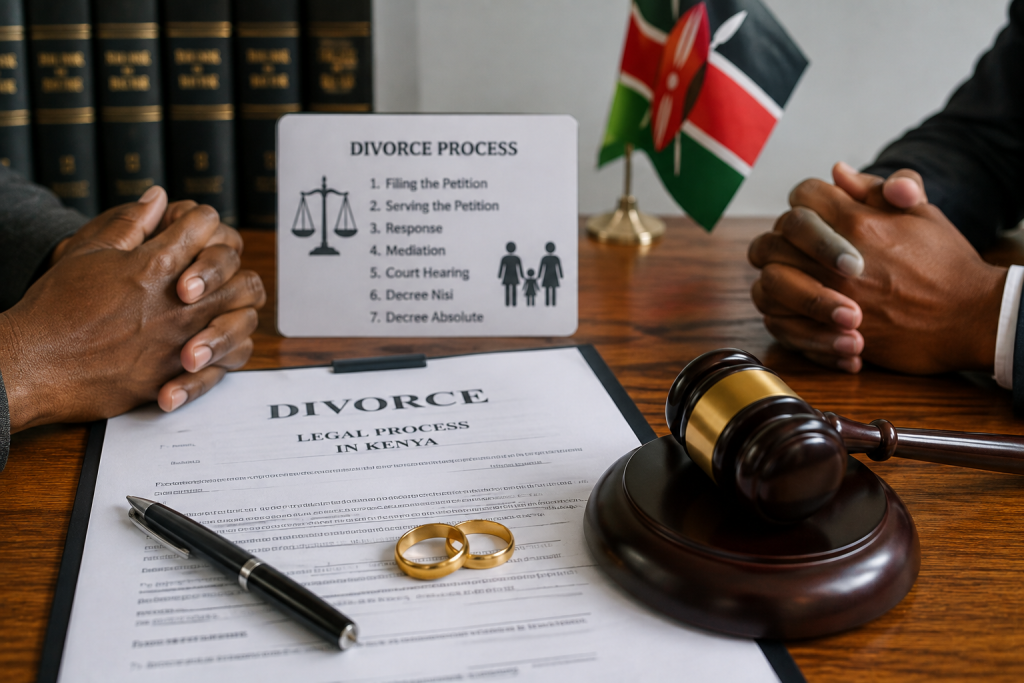
Step-by-Step: The Divorce Process in Kenya
Step 1: Confirm Jurisdiction and Eligibility
Before filing, you’ll need to confirm that either you or your spouse is domiciled in Kenya or holds Kenyan citizenship, since this establishes the court’s jurisdiction to hear the matter. You’ll also need to identify at least one recognized legal ground for divorce that applies to your situation and type of marriage.
Step 2: Prepare and File the Divorce Petition
The petitioner files a formal divorce petition, generally at the Family Division of the High Court (or, in some cases, the Magistrate’s Court), setting out the facts of the marriage, the specific ground(s) relied upon, and any ancillary relief being sought — such as child custody, division of matrimonial property, or spousal maintenance. This is typically accompanied by:
- The original marriage certificate
- A verifying affidavit
- Witness statements and a list of witnesses
- Supporting evidence for the grounds relied upon (for example, documentation or witness accounts supporting a claim of cruelty, desertion, or adultery)
Filing fees for an uncontested divorce are relatively modest, generally in the range of KSh 2,000 to KSh 20,000, depending on the specific court and nature of the filing.
Step 3: Service of the Petition
Once filed, the court issues a notice to appear, which must be formally served on the other spouse (the respondent), informing them of the petition. The respondent generally has 14 days to enter an appearance, and then a further period — commonly around 15 days — to file a formal response, which may either accept the divorce or contest it and the terms attached to it. Where a respondent cannot be located or is outside Kenya, the court can permit substituted service by other means, including, in some circumstances, electronic communication.
Step 4: Contested vs. Uncontested Proceedings
This is where the process meaningfully splits into two different paths:
- Uncontested divorce. Both spouses agree to the divorce and its terms. This path moves considerably faster, costs significantly less, and generally proceeds to a hearing without the need for extensive litigation.
- Contested divorce. One spouse disputes the divorce itself, or disputes the terms — custody, property division, or maintenance. In this case, both parties present evidence and arguments before a judge, and the process typically takes considerably longer.
Step 5: Mediation (The 2026 Change Every Petitioner Should Know)
This is one of the most significant recent developments in Kenyan family law. Following the Judiciary’s April 2026 Mediation Summit, courts are now actively required to refer ancillary matters — property division, child custody, and maintenance — to mediation before scheduling a contested hearing on those issues. This does not replace the requirement for a judicial decree to actually dissolve the marriage itself, but it does mean that disputes over property, children, and financial support are now generally expected to go through a structured mediation process first, with any resulting agreement recorded as an enforceable court consent order.
In practice, this shift tends to benefit petitioners: mediated settlements are typically faster, less expensive, and less emotionally damaging than a fully contested hearing — though it also means working with a lawyer who is genuinely skilled in negotiation, not just litigation, matters more than ever.
Step 6: Court Hearing and Decree Nisi
If the divorce proceeds — whether uncontested or after a contested hearing — and the court is satisfied that a valid ground has been established, it issues a Decree Nisi. This is a provisional order signaling the court’s intent to dissolve the marriage; it is not yet final. The Decree Nisi typically remains in effect for 30 days, a window intended to allow for the possibility of reconciliation, or for either party to raise an objection.
Step 7: Decree Absolute
Once the 30-day period lapses without objection, the petitioner (or, in some cases, the respondent) can apply for a Decree Absolute — the final court order that legally and formally dissolves the marriage. From this point, both parties are legally free to remarry, and the terms of any agreed or court-ordered division of property, custody, and maintenance become enforceable.
What Happens to Property, Custody, and Maintenance?
Matrimonial Property
Kenyan courts divide matrimonial property according to the Matrimonial Property Act, 2013, based on each spouse’s contribution to its acquisition — both monetary and non-monetary. Non-monetary contributions can include domestic work, childcare, companionship, and managing the family home or a family business. Kenyan courts, following a landmark Supreme Court ruling, have consistently confirmed that an automatic 50-50 split is not the standard; the actual division depends on each spouse’s demonstrated contribution.
Child Custody and Maintenance
Custody and maintenance matters are generally handled with the child’s best interests as the overriding consideration, guided by the Children Act, 2022, and — where these become contested — are increasingly first routed through mediation under the 2026 Judiciary directive before proceeding to a contested hearing.
How Long Does a Divorce Take in Kenya?
This varies significantly based on whether the divorce is contested:
- Uncontested divorces, where both spouses agree on the divorce and its terms, can move through the court process in a matter of months, particularly now that ancillary matters can often be resolved through mediation rather than a lengthy hearing.
- Contested divorces, especially those involving disputed property, custody, or serious factual disagreement over the grounds themselves, can take considerably longer — commonly well over a year, particularly where multiple hearings, mediation attempts, and appeals are involved.
How Much Does a Divorce Cost in Kenya?
Costs depend heavily on whether the case is contested:
- Uncontested divorces commonly range from around KSh 50,000 to KSh 150,000 in total legal fees, on top of the relatively modest court filing fees.
- Contested divorces, involving extended litigation, expert evidence, and multiple hearings, can exceed KSh 200,000, sometimes significantly more depending on complexity.
While it’s technically possible to represent yourself, given how much can be at stake — property, children, and your financial future — working with an experienced family law advocate is strongly recommended, particularly where the case is contested or involves significant assets.
Common Mistakes That Slow Divorces Down
- Filing without complete documentation. Missing marriage certificates, incomplete evidence for the grounds relied upon, or improperly prepared affidavits are among the most common causes of delay.
- Underestimating the mediation process. With the 2026 directive now routing ancillary matters through mediation, going in unprepared — without a clear position on property or custody — can prolong resolution.
- Attempting to serve a spouse informally. Service of the petition must follow proper legal procedure; informal notice generally isn’t sufficient and can stall the case.
- Not addressing ancillary matters early. Waiting until late in the process to raise property division or custody concerns often leads to unnecessary delay and additional hearings.
Divorce and Its Connection to Other Legal Matters
Divorce rarely exists in isolation from other legal concerns. Where matrimonial property includes land, disputes can intersect with broader family land disputes, particularly where property was inherited or jointly held across generations. If a spouse passes away during or after the process, questions may also arise regarding the succession process in Kenya. And where one spouse needs to authorize someone to manage their affairs during a lengthy or contested process — particularly if they’re living abroad — a properly drafted power of attorney can be an important supporting document. For a broader look at how Kenyan family law is currently handled, including the 2026 mediation shift in more depth, our guide to family lawyers in Kenya is a useful companion to this article.
Frequently Asked Questions
How long do you need to be married before you can file for divorce in Kenya?
For civil marriages, the law generally requires the marriage to have lasted at least three years before a petition can be filed, except in cases of exceptional hardship. This restriction generally doesn’t apply to customary or Islamic marriages.
What documents do I need to file for divorce in Kenya?
Typically required documents include the divorce petition, a verifying affidavit, witness statements and a list of witnesses, supporting evidence for your grounds, the marriage certificate, and a notice to appear.
What is the difference between a Decree Nisi and a Decree Absolute?
A Decree Nisi is a provisional order signaling the court’s intent to dissolve the marriage, typically remaining in effect for 30 days to allow for possible reconciliation. A Decree Absolute is the final order that legally dissolves the marriage.
Do all divorce cases in Kenya now go through mediation?
As of the Judiciary’s April 2026 directive, ancillary matters — property division, custody, and maintenance — are generally referred to mediation before a contested hearing. The dissolution of the marriage itself, however, still requires a formal court decree.
How is property divided in a Kenyan divorce?
Property is divided based on each spouse’s contribution to its acquisition, both monetary and non-monetary, under the Matrimonial Property Act, 2013. Courts have confirmed this is not an automatic 50-50 split.
Can I get divorced in Kenya without going to court?
No — for civil marriages, a court decree is always required to legally dissolve the marriage, even where the divorce itself is uncontested. Mediation can resolve ancillary issues like property and custody, but not the dissolution of the marriage itself.
How is an Islamic divorce different from other types in Kenya?
Islamic marriages are governed by Sharia law and handled through the Kadhi’s Courts rather than the Family Division of the High Court, with different grounds and procedures than civil, Christian, Hindu, or customary marriages.
Why AWK Advocates Is the Right Choice for Your Divorce
Going through a divorce is difficult enough without also having to navigate an unfamiliar legal process alone. AWK Advocates is Nairobi’s trusted choice for guiding clients through the divorce process in Kenya, from the very first consultation through to a finalized Decree Absolute — whether your case is straightforward and uncontested, or complex and contested across property, custody, and maintenance.
From the outset, our team takes the time to understand your specific circumstances, explain your realistic options in plain language, and build a strategy suited to how you want to move forward — whether that means pursuing an amicable, mediation-first resolution wherever possible under the 2026 Judiciary directive, or preparing rigorously for a contested hearing where your rights need to be firmly defended. Because divorce so often intersects with property, land, and succession matters, AWK Advocates brings that same depth of understanding across each of these connected areas, so you’re never left coordinating between multiple disconnected advisors during an already difficult time.
📞 Call or WhatsApp us on +254 722 957288, or get in touch with AWK Advocates for a confidential consultation about your divorce.
Divorce Process in Kenya
The divorce process in Kenya follows a clear legal structure — from establishing the right ground under the Marriage Act, through filing and service, to the 2026 mediation requirement for ancillary matters, and finally the Decree Nisi and Decree Absolute that formally end the marriage. But understanding that structure is only half the picture; how smoothly, quickly, and fairly your specific case moves through it depends heavily on the quality of documentation, preparation, and legal guidance behind it.
Whatever stage you’re at — still weighing the decision, ready to file, or already navigating a contested dispute over property or custody — AWK Advocates is ready to walk through this season with you, combining genuine legal expertise in Kenya’s family law framework with the clarity and compassion this process deserves. If you’re ready to understand exactly where you stand and what your best path forward looks like, reach out today for a confidential conversation.
