
How to Register an NGO in Kenya – Registration of an NGO in Kenya: A Complete Guide (2026)
Non-Governmental Organizations (NGOs) have emerged as key actors in Kenya’s development landscape, driving initiatives in education, healthcare, agriculture, environmental conservation, social research, humanitarian relief, and economic empowerment. The appeal of NGOs lies in their ability to serve public interest without the aim of profit. They channel resources and expertise into projects that improve the well-being of communities and the environment. However, operating an NGO legally in Kenya requires formal registration under the Public Benefit Organizations Act 2013, which ensures that organizations adhere to national standards of governance, accountability, and financial transparency. Legal registration does more than satisfy statutory requirements. It conveys legitimacy, enhances credibility with donors and partners, opens access to government grants and tax exemptions, and establishes a framework for sustainable operations. NGOs that fail to register or operate informally face penalties, reputational risks, and limitations in fundraising and project implementation. At AWK Advocates, we provide comprehensive support to ensure that organizations understand every legal requirement, procedural step, and operational expectation before launching their activities in Kenya.
What Is an NGO in Kenya and Why Registration Matters
An NGO in Kenya is formally recognized as a private, voluntary, non-profit organization that operates to promote public welfare and social development. Unlike businesses that generate profits for owners or shareholders, NGOs direct all revenue toward achieving their social mission. They can operate at a local, national, or international level, focusing on a range of areas including healthcare provision, educational initiatives, agricultural support, environmental sustainability, disaster response, and research activities. Registration is not merely a bureaucratic formality but a strategic step that secures legal recognition, builds institutional credibility, and ensures compliance with national laws. Registered NGOs can own property, enter into contracts, hire employees, and engage in legal proceedings in their corporate name. From a donor perspective, registration signals accountability and trustworthiness. Funding agencies, both local and international, typically require registration before providing grants, partnerships, or technical support. Moreover, registration allows NGOs to access certain tax exemptions, reducing operational costs and enabling the organization to allocate more resources toward its mission.
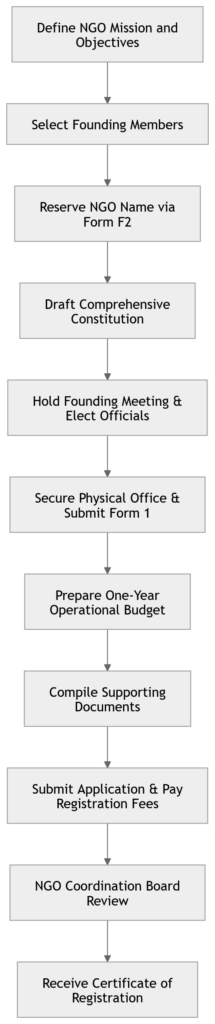
Step-by-Step Flow Diagram – NGO Registration Process in Kenya
This diagram illustrates the logical progression from defining the NGO’s purpose to obtaining legal recognition. Each stage requires careful attention, detailed documentation, and adherence to regulatory requirements.
NGO Registration Requirements in Kenya
Kenya’s legal framework for NGOs ensures that organizations operate ethically, transparently, and effectively. Complying with these requirements is essential for gaining approval and establishing a strong foundation for sustainable operations.
Leadership and Governance
Every NGO in Kenya must have at least five officials to ensure proper governance. The recommended leadership structure includes a Chairperson, Secretary, Treasurer, and two Board Members. Each official has defined responsibilities: the Chairperson oversees strategic direction and compliance; the Secretary maintains official records, minutes, and communications; the Treasurer handles financial reporting and budgeting; and the Board Members provide oversight and assist with policy-making. Officials must be individuals of high integrity, professional competence, and ethical standing. The law requires police clearance certificates, KRA PIN verification, and identification documents for all officials. These measures protect the NGO from fraud, mismanagement, and reputational risk. By ensuring that leadership is composed of trustworthy individuals, the NGO Coordination Board promotes accountability and public confidence.
Drafting the Constitution
The constitution is the legal backbone of the NGO, outlining governance structures, operational procedures, and accountability mechanisms. It should cover the organization’s mission, objectives, and core values, as well as membership rules, the roles and responsibilities of officials, financial management protocols, conflict-of-interest policies, meeting procedures, and mechanisms for resolving disputes. Importantly, the constitution must specify rules for awarding contracts and prohibit profit distribution to members, ensuring that all resources are used solely to advance the organization’s objectives. The constitution must also define procedures for dissolution, detailing how assets will be distributed in accordance with the law. A well-drafted constitution minimizes conflicts, ensures operational clarity, and enhances donor confidence.
Office Location and Contact Person
A registered physical office in Kenya is mandatory. The office serves as the operational hub for administrative functions, regulatory communications, and donor engagement. Form 1, submitted to the NGO Coordination Board, captures the office address and the designated contact person’s details. A clearly defined office location ensures transparency and facilitates inspections, monitoring, and official correspondence.
Financial Planning and Budgeting
A one-year operational budget is a crucial component of the registration process. The budget should outline all projected expenses, including program costs, staff salaries, office rent, utilities, administrative expenses, and contingency allocations. Preparing a realistic budget demonstrates financial prudence and operational readiness, which are critical criteria for approval. Moreover, a transparent budget allows donors to understand resource allocation and increases confidence in the organization’s ability to manage funds responsibly.
How to Start an NGO in Kenya – Detailed Step-by-Step Guide
Starting an NGO in Kenya involves multiple stages, each requiring attention to detail, legal compliance, and practical planning.
Step 1: Define the Mission and Objectives
The first step is to clearly articulate your NGO’s purpose. Whether the focus is healthcare, education, poverty alleviation, environmental protection, or social research, precise objectives help guide program design, operational planning, and fundraising strategies. For instance, an NGO targeting educational development might focus on scholarship programs, teacher training, or digital literacy initiatives. Clear objectives facilitate alignment among officials, attract donors, and ensure regulatory compliance.
Step 2: Select Founding Members
Select at least five founding members who demonstrate commitment, integrity, and professional competence. These members will serve as officials responsible for governance, decision-making, and oversight. Their credibility and experience are critical, as the NGO Coordination Board assesses leadership integrity during the registration process.
Step 3: Reserve the NGO Name
Reserve a unique and meaningful NGO name using Form F2. The reserved name is held for 60 days and provides time to prepare other registration requirements. The name should reflect the NGO’s mission and be distinct from existing entities to avoid conflicts.
Step 4: Draft the Constitution
Develop a comprehensive constitution that addresses all operational, governance, and financial management requirements. Ensure the document is signed by all founding members and board officials to demonstrate collective commitment and accountability.
Step 5: Hold the Founding Meeting
Conduct a formal meeting to elect officials, approve the constitution, and authorize submission of the registration application. Minutes of the meeting should document the decisions, agenda, and resolutions, with signatures of all attendees to validate authenticity.
Step 6: Secure a Physical Office
Establish a registered office in Kenya, which serves as the central operational hub. Submit the office details through Form 1. This ensures regulatory compliance, transparency, and ease of communication with donors and authorities.
Step 7: Prepare a Detailed Operational Budget
Draft a comprehensive one-year budget outlining all anticipated expenditures, program costs, and administrative expenses. Include contingency plans to handle unforeseen costs. This budget demonstrates financial preparedness and facilitates donor engagement.
Step 8: Compile Supporting Documents
Prepare all documents required by the NGO Coordination Board. This includes police clearance certificates, identification and KRA PIN documents, passport-sized photographs of officials, triplicate signed copies of the constitution, minutes of the founding meeting, operational budget, and any Memoranda of Understanding with donors. Accuracy, completeness, and proper organization are critical.
Step 9: Submit the Application and Fees
Submit the application package to the NGO Coordination Board along with the registration fee—Ksh 16,000 for national NGOs and Ksh 30,000 for international NGOs. Ensure receipts are attached, and the submission includes all supporting documentation.
Step 10: Board Review and Approval
The NGO Coordination Board reviews the application, verifies documents, and may conduct inspections. Once all criteria are met, the NGO receives a certificate of registration, granting legal recognition and operational legitimacy.

Documents Required for NGO Registration in Kenya – Comprehensive Checklist
Successfully registering an NGO in Kenya depends on meticulous documentation. The NGO Coordination Board scrutinizes every document to ensure transparency, governance, and compliance. Preparing these documents carefully reduces delays and increases the likelihood of approval.
- Registration Request Letter
A formal letter addressed to the Executive Director of the NGO Coordination Board must clearly express the intention to register the organization. The letter should highlight the NGO’s objectives, scope of work, operational area, and commitment to compliance with Kenyan laws. Including a brief summary of programs and anticipated community impact demonstrates seriousness and organizational readiness. - Name Reservation Form (F2)
The reserved NGO name must be submitted with proof of payment. The form must reflect the exact spelling and structure of the NGO’s name as it will appear on all legal documents, ensuring that there is no ambiguity or duplication with existing organizations. - Completed Forms 1 and 3
Form 1 specifies the organization’s contact person and office location, while Form 3 captures detailed information about the NGO’s officials, governance, and operational plan. Both forms must be filled accurately, signed by the relevant officials, and submitted in original copies. - Constitution of the NGO
Submit three copies of the signed constitution, ensuring that all founding members and board members sign each copy on the execution page. Each page should bear signatures of at least one official to affirm authenticity. The constitution should clearly define roles, responsibilities, and governance procedures, including conflict-of-interest policies and financial management frameworks. - Police Clearance Certificates
All Kenyan officials must provide a certificate of good conduct, including fingerprints and official receipts. Foreign officials must submit equivalent notarized clearance certificates from their country of origin, not older than six months. This ensures that the NGO operates with trustworthy personnel. - Identification Documents and KRA PIN Certificates
Each official must submit a valid identification card or passport along with a KRA PIN certificate. These documents verify identity and tax compliance, reinforcing legal and financial accountability. - Passport-Size Photographs
Two recent colored passport-sized photographs of each of the three officials and at least two board members are required. Names of individuals and the NGO should be written on the back to avoid confusion during processing. - Minutes of Founding Meeting
The minutes should include the agenda, resolutions, election of interim officials, and approval of the constitution. Proper documentation ensures a clear record of organizational decisions, which is vital for compliance and auditing purposes. - Operational Budget
The proposed one-year budget should outline all projected expenditures, including program costs, staff remuneration, office rent, utilities, and contingency allocations. Attaching a budget demonstrates organizational readiness and sound financial planning. - Memorandum of Understanding (If Applicable)
For NGOs with donor partnerships or branch affiliations, a formal MoU must be submitted. This confirms agreements, funding commitments, and roles of all involved parties.
Additional Requirements for Foreign NGOs Operating in Kenya
Foreign NGOs are subject to stricter regulations to ensure compliance with Kenyan law and protection of public interest:
- At least one top official must be a Kenyan citizen.
- The NGO must submit constitutions of all foreign branches to demonstrate alignment with governance practices.
- Officials must have unquestionable character and meet ethical standards equivalent to those expected of Kenyan officials.
- Documentation must be notarized and legalized, including police clearance, corporate registration, and financial statements from the parent organization.
These measures ensure that foreign NGOs operate transparently, prevent exploitation of resources, and maintain alignment with local development priorities.
Governance, Compliance, and Post-Registration Responsibilities
Registration is just the beginning. A well-governed NGO must maintain compliance and operational integrity to sustain credibility:
- Annual Reporting – NGOs must submit detailed annual reports on activities, achievements, and finances to the NGO Coordination Board. Accurate reporting reflects accountability and transparency.
- Financial Audits – Regular internal and external audits are essential to ensure proper use of funds and compliance with the constitution. Donors often require audited financial statements before funding projects.
- Operational Reviews – Periodic evaluation of program delivery ensures that objectives are being met, identifies challenges, and supports continuous improvement.
- Governance Updates – NGOs should review their constitutions and policies regularly to reflect best practices, legal changes, and evolving operational needs.
- Stakeholder Engagement – Maintaining open communication with donors, beneficiaries, and government agencies builds trust and encourages collaboration.
Legal Pitfalls and Common Challenges to Avoid
While registration is straightforward, NGOs frequently encounter challenges:
- Incomplete documentation – Missing forms, unsigned constitutions, or absent police clearance can delay approval.
- Ambiguous objectives – Vague descriptions of purpose or activities may lead to application rejection.
- Weak governance structures – Lack of clearly defined roles and responsibilities raises concerns with the Board.
- Financial ambiguity – Budgets that are unrealistic or insufficiently detailed undermine confidence.
- Non-compliance with office requirements – NGOs without a registered physical office may face scrutiny or rejection.
Being aware of these pitfalls and addressing them proactively increases the likelihood of smooth registration.
Estimated Costs and Processing Timeline
Cost Overview:
- National NGOs: Ksh 16,000 – Ksh 20,000
- International NGOs: Ksh 30,000 – Ksh 150,000 (depending on documentation and legal support)
Timeline:
- Name Reservation: 1–2 weeks
- Document Preparation: 2–4 weeks
- Submission & Payment: 1–2 days
- Board Review & Verification: 4–8 weeks
- Certificate Issuance: 1–2 weeks
A carefully prepared application can reduce delays and ensure a timely registration process.
Best Practices for Newly Registered NGOs
- Program Planning: Implement projects aligned with your stated objectives. Ensure measurable outcomes and impact evaluation.
- Financial Management: Maintain meticulous financial records and ensure funds are used strictly for intended purposes.
- Transparency and Reporting: Submit timely reports and engage with stakeholders regularly.
- Capacity Building: Train officials and staff to enhance organizational efficiency and governance practices.
- Sustainability: Plan long-term strategies, including fundraising, community partnerships, and advocacy programs.
Following these practices ensures your NGO operates effectively, complies with legal standards, and builds credibility with the public and donors.
How to Register an NGO in Kenya
Registering an NGO in Kenya is a critical legal, operational, and strategic step that transforms a social initiative into a legitimate, accountable, and credible organization. By following the steps outlined in this guide—from defining objectives, selecting officials, drafting the constitution, preparing a budget, to submitting a comprehensive application—your NGO can operate legally and effectively, attracting donors, building trust, and maximizing community impact.
At AWK Advocates, we provide end-to-end guidance, ensuring every aspect of your NGO’s registration and governance meets regulatory requirements. Our support guarantees that your organization not only gains legal recognition but also establishes a strong foundation for sustainable operations and social impact.