
Land Grabbing in Kenya | What to Do If Your Land Is Grabbed in Kenya (AWK Advocates Guide)
At AWK Advocates, we recognize that land grabbing in Kenya remains one of the most serious and rapidly increasing legal challenges affecting landowners, investors, and families. It involves unlawful occupation, fraudulent transfer of ownership, and illegal interference with registered land titles. These disputes often arise due to weak documentation, forgery, corruption within land registries, and failure by landowners to actively monitor their property rights. In many cases, individuals discover too late that their land has been illegally transferred or occupied, making recovery more complex and legally demanding.
Land grabbing in Kenya is not only a violation of property rights but also a direct infringement of constitutional protections under Kenyan law. At AWK Advocates, we assist clients in addressing these disputes through structured legal intervention, evidence-based claims, and enforcement of rightful ownership. Our experience shows that early action significantly increases the chances of successful recovery. This guide provides a clear, practical, and legally sound framework for dealing with land grabbing in Kenya, helping property owners understand their rights, legal options, and the correct procedures to follow when their land is unlawfully taken.

Understanding Land Grabbing in Kenya: Legal Definition and Real-World Triggers
Land grabbing in Kenya refers to the illegal acquisition, occupation, or transfer of land without lawful authority. It manifests in fraudulent title transfers, forged ownership documents, unauthorized fencing or development, abuse of administrative loopholes, and collusion with land officials.
High-risk scenarios include absentee landowners failing to monitor property, incomplete documentation, double allocation of parcels, historical land injustices, and weak enforcement at land registries. Early warning signs include sudden fencing, unknown occupants, discrepancies in records, and third-party ownership claims.
Step 1: Verify Ownership Through Official Land Records
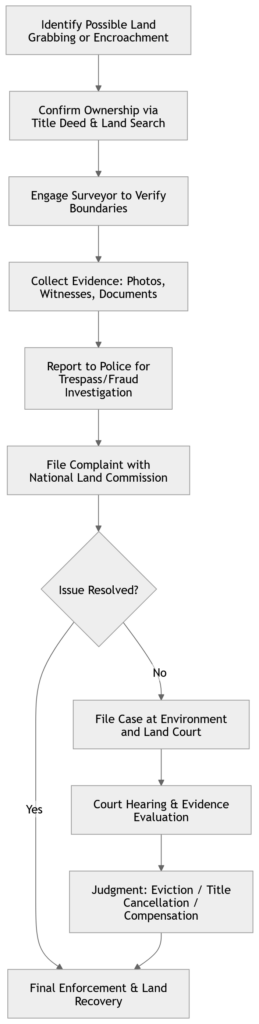
Before action, confirm ownership through title deeds and registry searches. A land search reveals the registered owner, encumbrances, and ownership history, exposing fraud or illegal transfers. A licensed surveyor should confirm boundaries using official maps and issue a report identifying encroachment accurately.
Step 2: Secure Evidence and Document the Encroachment
Strong evidence is critical. Collect photographs, videos, witness statements, survey reports, historical land records, and official registry searches. Proper documentation strengthens both administrative and court claims.
Step 3: Report the Matter to Law Enforcement Immediately
File a police report in cases of trespass, fraud, forgery, or illegal occupation. Submit ownership documents, visual evidence, and witness statements. This creates an official record and may trigger investigations or arrests.
Step 4: File a Complaint with the National Land Commission (NLC)
The NLC handles disputes involving historical injustices, illegal allocations, and public land issues. Submit parcel details, dispute description, timeline, and supporting evidence. The Commission may investigate and revoke fraudulent titles where necessary.
Step 5: Initiate Proceedings in the Environment and Land Court
If unresolved, file a case in the Environment and Land Court. Actions may include eviction claims, ownership determination, injunctions, and title cancellation. Courts may also award compensation or permanent restraining orders against trespassers.
Step 6: Use Alternative Dispute Resolution (ADR) Where Strategic
ADR includes mediation, negotiation, or arbitration. It reduces costs, speeds resolution, and preserves relationships, but should never compromise ownership rights.
Step 7: Prevent Future Land Grabbing Through Proactive Measures
Secure land through fencing, signage, and regular inspections. Register caveats to block unauthorized transactions and maintain updated records. Continuous monitoring and community engagement strengthen protection against future disputes.
Common Mistakes Victims Make in Land Grabbing Cases
Many landowners in Kenya lose their cases or delay recovery due to avoidable mistakes. One of the most common errors is failing to conduct an immediate official land search after noticing suspicious activity on the property. Without confirming ownership status early, victims often act on assumptions rather than legal facts.
Another major mistake is confronting the alleged land grabbers directly instead of following legal procedures. This can escalate conflict and weaken the case. Many victims also delay reporting the matter to authorities, which allows fraudulent transfers or illegal developments to progress further.
Failure to gather proper documentation such as title deeds, sale agreements, and survey reports also significantly weakens a claim. In addition, some landowners ignore the importance of legal representation early in the process, which leads to procedural errors when filing complaints or court cases. Avoiding these mistakes is essential for successful land recovery in Kenya.
Land Recovery Process Flow
Frequently Asked Questions (FAQ)
How long does land recovery take in Kenya?
The duration of land recovery in Kenya depends on the complexity of the dispute. Simple cases resolved through administrative channels may take a few months, while contested cases in the Environment and Land Court can take several months to several years depending on evidence and court backlog.
Can land be recovered without a title deed?
Yes, land can sometimes be recovered without a physical title deed, but it becomes more difficult. Courts and land authorities may rely on alternative evidence such as sale agreements, land registry records, witness statements, and historical ownership documents.
Which court handles land grabbing cases in Kenya?
Land grabbing cases in Kenya are handled by the Environment and Land Court, which has jurisdiction over land ownership disputes, eviction orders, title cancellation, and related property matters.
How AWK Advocates Can Help
At AWK Advocates, we provide specialized legal support in land grabbing cases across Kenya. We assist clients in verifying land ownership through official searches, gathering strong legal evidence, and preparing structured claims for both administrative bodies and courts.
Our team handles the full legal process, including filing complaints with the National Land Commission, initiating proceedings in the Environment and Land Court, and negotiating settlements where appropriate. We also guide clients on preventive legal measures such as caveats, land audits, and compliance checks to protect property rights.
With experience in complex land dispute resolution in Kenya, AWK Advocates ensures that every case is handled with precision, urgency, and full legal compliance to maximize recovery success.
Land Grabbing in Kenya
Successfully addressing land grabbing in Kenya requires a combination of legal awareness, timely action, and structured enforcement of property rights. Many land disputes escalate because owners delay verification, fail to act quickly, or lack proper legal guidance. Through a systematic approach involving ownership confirmation, evidence collection, administrative reporting, and court action where necessary, landowners can significantly improve their chances of reclaiming stolen or illegally occupied property.
At AWK Advocates, we position ourselves as a trusted legal partner in resolving land disputes in Kenya by offering structured legal strategies, professional representation, and strong advocacy in both administrative and judicial processes. Building authority in this area requires consistent legal documentation, deep topical coverage, and continuous reinforcement of expertise in land law matters.
Ultimately, land grabbing in Kenya is best addressed through vigilance, documentation, and decisive legal action. With the right legal strategy, landowners can not only recover their property but also prevent future disputes. AWK Advocates remains committed to guiding clients through every stage of land dispute resolution, ensuring justice, protection of rights, and long-term security of ownership.