
What is Summary Dismissal In kenya: A Complete Legal Guide for Employers and Employees
Understanding what is summary dismissal is essential for both employers and employees in Kenya because it touches directly on the rights, duties, and responsibilities that arise within an employment relationship. Employment law in Kenya is structured to protect both parties, ensuring that employers can maintain discipline and productivity in the workplace while employees are shielded from arbitrary or unfair termination. Summary dismissal is therefore a legal mechanism that allows an employer to terminate an employee’s contract instantly in circumstances where the employee’s conduct has fundamentally breached the employment relationship.
This detailed guide, prepared with reference to employment law principles applied in Kenya and insights associated with AWK Advocates, explains the meaning of summary dismissal, the legal framework governing it, the circumstances under which it may occur, the procedures employers must follow, and the rights employees retain even after such dismissal.
What is Summary Dismissal?
Summary dismissal is a form of termination where an employer ends an employee’s contract immediately and without notice due to serious misconduct. The concept is grounded in the idea that certain actions by an employee can destroy the trust and confidence required for the continuation of an employment relationship.
When examining what is summary dismissal, it becomes clear that it differs significantly from ordinary termination. In normal termination cases, employees are usually entitled to a notice period or payment in lieu of notice. However, in summary dismissal situations, the misconduct is considered so severe that the employer is legally permitted to terminate the employment relationship instantly.
The underlying principle is that the employee has committed an act that is incompatible with their duties or obligations under the employment contract. When such conduct occurs, the employer may reasonably conclude that continuing the employment relationship is no longer possible.
Legal practitioners at AWK Advocates, a firm experienced in employment law matters in Kenya, emphasize that although summary dismissal allows immediate termination, it must still comply with the legal safeguards established under Kenyan labour law.
Legal Framework Governing Summary Dismissal in Kenya
The legal understanding of what is summary dismissal in Kenya is primarily derived from the Employment Act, 2007, which outlines the conditions under which an employer may dismiss an employee without notice. The law recognizes that employers must have the ability to address severe misconduct, but it also ensures that employees are not dismissed arbitrarily or unfairly.
The Employment Act provides the statutory foundation that governs termination procedures, disciplinary hearings, and employee protections. Courts in Kenya, particularly the Employment and Labour Relations Court, have consistently emphasized that even when an employer believes summary dismissal is justified, the dismissal must still be carried out in a fair and lawful manner.
This means the employer must demonstrate two key elements. First, there must be a valid and justifiable reason for the dismissal. Second, the employer must follow a fair procedure before making the final decision to terminate the employee’s contract.
Failure to satisfy these requirements can lead to the dismissal being declared unfair, which may expose the employer to legal liability, including compensation awards to the employee.
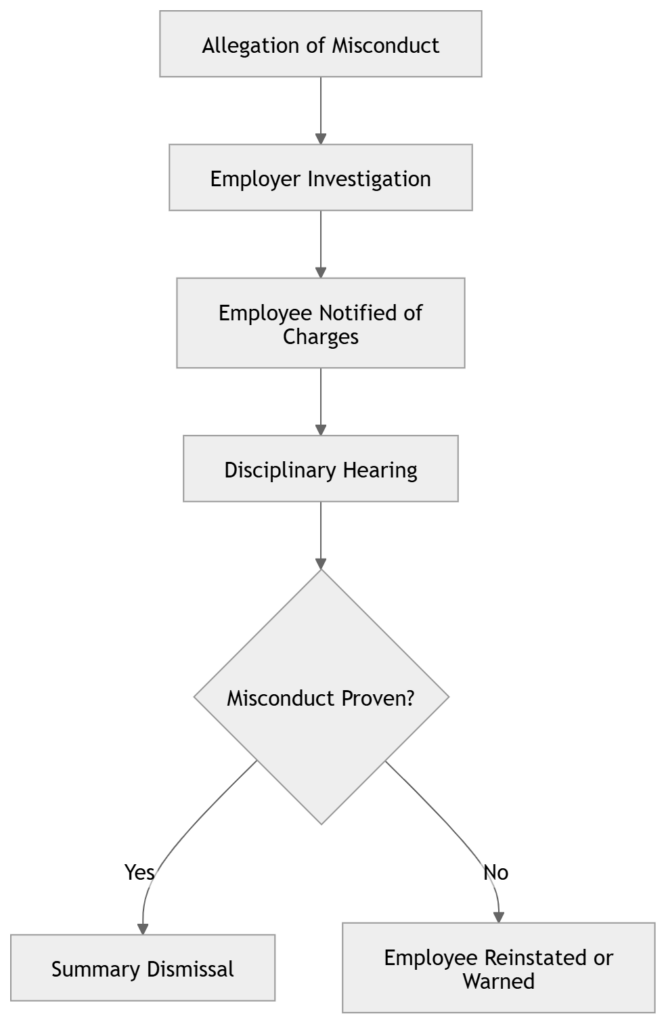
The Summary Dismissal Process in Kenya
Circumstances That May Lead to Summary Dismissal
To fully understand what is summary dismissal, it is necessary to examine the types of misconduct that may justify such a drastic employment action. These situations usually involve behavior that significantly violates workplace policies or demonstrates dishonesty, insubordination, or gross negligence.
One common circumstance that can lead to summary dismissal is theft or fraudulent conduct involving the employer’s property or finances. If an employee is found to have stolen company property, manipulated financial records, or engaged in fraudulent activities, the employer may determine that trust has been irreparably broken. In such cases, maintaining the employment relationship becomes impossible.
Another situation involves persistent absenteeism without authorization. When an employee repeatedly fails to report to work without explanation or permission, the employer may interpret this as a serious breach of contractual obligations. Employment contracts typically require employees to attend work regularly and perform assigned duties, and failing to do so may justify dismissal.
Insubordination may also result in summary dismissal. This occurs when an employee deliberately refuses to follow lawful and reasonable instructions from supervisors or management. Organizations rely on hierarchical structures to maintain efficiency, and deliberate defiance of authority can disrupt operations and undermine workplace discipline.
Serious misconduct may also arise when an employee reports to work while intoxicated by alcohol or drugs, particularly if the nature of their work involves safety-sensitive tasks. For example, employees operating machinery or handling sensitive equipment must maintain a clear and sober state of mind. Intoxication in such circumstances can endanger colleagues, customers, and the organization itself.
Similarly, violence or abusive conduct in the workplace may justify immediate dismissal. Threatening colleagues, engaging in physical fights, or using offensive and abusive language can create a hostile work environment that employers are obligated to prevent.
Procedural Fairness in Summary Dismissal
Although summary dismissal allows immediate termination, Kenyan law places strong emphasis on procedural fairness. Understanding this aspect is crucial when exploring what is summary dismissal, because the absence of due process can render the dismissal unlawful.
Employers must first inform the employee of the allegations against them. The employee should clearly understand what misconduct they are accused of committing. Transparency at this stage is important because it ensures that the employee has an opportunity to prepare a response.
After notifying the employee, the employer should conduct a disciplinary hearing. During this hearing, the employee must be allowed to present their explanation or defense regarding the allegations. The purpose of this process is not merely to fulfill a legal requirement but to ensure that decisions are made based on accurate information and fair consideration.
Kenyan labour law also allows the employee to be accompanied by another employee or union representative during the hearing. This right ensures that the employee is not disadvantaged or intimidated during the disciplinary process.
The employer must then evaluate the evidence presented and determine whether the misconduct justifies summary dismissal. This decision should be documented clearly, including the reasons for dismissal and the evidence supporting the conclusion.
Legal experts at AWK Advocates frequently advise employers to maintain proper records of disciplinary proceedings. Documentation such as warning letters, investigation reports, and hearing minutes can be critical if the dismissal is later challenged in court.
Employee Rights After Summary Dismissal
Many employees assume that once summary dismissal occurs, they lose all legal protections. However, this is not accurate. Understanding what is summary dismissal also requires understanding the rights that employees retain even after termination.
An employee who believes they were dismissed unfairly has the right to challenge the dismissal through legal channels. They may file a complaint with the labour office or pursue legal action through the Employment and Labour Relations Court.
Even in cases of summary dismissal, employees may still be entitled to certain accrued benefits. These may include unpaid wages for days already worked, accumulated leave days, and other benefits stipulated in the employment contract.
If a court determines that the dismissal was unfair, the employee may receive compensation or other remedies. In some cases, courts have ordered employers to pay compensation equivalent to several months’ salary, depending on the circumstances surrounding the dismissal.
When Summary Dismissal Becomes Unfair
A critical aspect of understanding what is summary dismissal involves recognizing when it becomes unfair or unlawful. Kenyan courts frequently review employment disputes where employers have failed to follow proper procedures.
Summary dismissal may be declared unfair if the employer did not conduct a disciplinary hearing, failed to provide evidence supporting the allegations, or dismissed the employee without giving them an opportunity to respond.
Another situation that may lead to a finding of unfair dismissal occurs when the employer imposes summary dismissal for a minor offense that does not justify such a severe penalty. Courts generally assess whether the punishment was proportionate to the misconduct.
Employers who fail to comply with the legal requirements risk facing financial penalties, reputational damage, and legal disputes that could have been avoided through proper procedures.
Why Understanding Summary Dismissal Matters
The topic of what is summary dismissal is important because it directly affects workplace stability, employee rights, and employer responsibilities. When employers understand the legal framework governing summary dismissal, they can enforce discipline while minimizing the risk of legal disputes.
Employees also benefit from understanding their rights because it enables them to recognize when termination procedures have not been followed correctly. Knowledge of the law empowers employees to seek legal remedies when necessary.
Organizations that maintain transparent disciplinary procedures tend to experience fewer employment disputes, stronger workplace morale, and improved trust between management and staff.
What is summary dismissal?
The concept of what is summary dismissal forms a critical part of employment law in Kenya. It allows employers to terminate employment immediately when serious misconduct occurs, but it also imposes strict legal requirements to ensure fairness and accountability.
Employers must establish valid reasons for dismissal and follow procedural safeguards before making such decisions. Employees, on the other hand, retain the right to challenge unfair dismissals and claim appropriate remedies when their rights are violated.
For organizations and individuals seeking deeper legal guidance on employment law matters, insights from AWK Advocates help clarify the complexities surrounding summary dismissal and ensure that workplace decisions comply fully with Kenyan labour law.