
How To Register A Foundation in Kenya (2026 Guide) | How To Register A Charity Organisation in Kenya: Company Limited by Guarantee Process, Legal Requirements & Compliance Roadmap
We recognize that establishing a charitable foundation in Kenya requires a clear legal structure that ensures credibility, compliance, and long-term operational stability. In most cases, non-profit organizations are incorporated either under the Companies Act, 2015 through the Business Registration Service (BRS) or under the Public Benefits Organisations (PBO) framework, depending on the intended operational scope and regulatory preference.
Among these options, registration as a Company Limited by Guarantee (CLG) remains the most widely adopted structure due to its efficiency, flexibility, and relatively streamlined requirements. This model is especially suitable for charitable, educational, religious, scientific, and community-based organizations that do not distribute profits to members.
Understanding a Company Limited by Guarantee in Kenya
A Company Limited by Guarantee is a legal entity that does not have share capital. Instead of shareholders, it has members (guarantors) who commit to contributing a nominal amount in the event of winding up.
This structure is ideal for foundations because:
- It prohibits profit distribution to members
- It ensures all income is reinvested into organizational objectives
- It enhances donor trust and international funding eligibility
- It provides full legal personality for contracts, banking, and compliance
Step-by-Step Procedure for Registration of a Charitable Foundation in Kenya
1. Name Reservation and Approval at BRS
The registration journey begins with selecting and reserving a unique name for the foundation.
We follow this structured process:
- Propose at least three name options in order of preference
- Conduct a name search through the BRS system to confirm availability
- Ensure the proposed name is not identical or confusingly similar to existing entities
- Submit a name reservation application
Once approved, the name is reserved for a limited period (usually up to 30 days), allowing sufficient time to complete incorporation documents.
2. Drafting of Memorandum and Articles of Association (MEMARTS)
The MEMARTS form the constitutional backbone of the foundation. These documents define purpose, governance, and operational rules.
Key inclusions in the Memorandum:
- Clear statement that the company is Limited by Guarantee
- Defined charitable objectives such as:
- Education and training
- Health and humanitarian support
- Environmental conservation
- Scientific and community development initiatives
- Identification of guarantors and their nominal contribution obligations in case of winding up
Articles of Association cover:
- Internal governance structure
- Appointment and removal of directors
- Meeting procedures and voting rights
- Financial management rules
- Asset distribution upon dissolution (strictly non-profit redistribution rules)
Essential restrictive clauses:
- No distribution of profits to members
- All income must be applied solely to the organization’s objectives
- Asset lock provisions to prevent misuse of funds
3. Preparation and Filing of Incorporation Documents
At this stage, we prepare and submit all required statutory forms through the BRS system.
Core registration documents include:
Form CR1 – Application for Registration
This is the primary incorporation document capturing:
- Name of the foundation
- Registered office address
- Objectives of the organization
- Details of directors and guarantors
Form CR2 – Memorandum of Guarantee
This document confirms:
- The guarantee commitment by members
- The nominal amount payable in case of winding up
Form CR8 – Registered Office Address
This confirms:
- Physical location of the foundation within Kenya
- Full address details including building, street, and town
Form CR7 – Appointment of Directors and Company Secretary
This captures:
- Initial directors
- Company secretary details (if applicable)
- Governance structure at inception
4. Director and Member Documentation Requirements
Each director and guarantor must provide verified personal information for compliance purposes.
We ensure the following details are accurately submitted:
- National ID or Passport number
- KRA PIN
- Passport-size colored photograph
- Residential address (including road, estate, and house number)
- Email address and phone contact
- Postal address
These requirements ensure transparency and regulatory compliance under Kenyan company law.
5. Vetting and Security Clearance Process
After submission, the registration documents undergo a mandatory vetting process conducted through relevant government agencies, including national security verification.
This stage typically involves:
- Review of director backgrounds
- Validation of identity documents
- Compliance checks against legal and security databases
The vetting period may take up to 21 days, depending on the complexity of the application and regulatory workload.
6. Issuance of CR3 and Statement of Guarantee
Once vetting is successfully completed:
- The system issues a CR3 clearance certificate, confirming approval from security authorities
- A formal statement of guarantee is generated and signed
This step confirms that the foundation meets all legal integrity requirements for incorporation.
7. Certificate of Incorporation
Upon completion of all processes, the Business Registration Service issues the Certificate of Incorporation.
This certificate:
- Legally recognizes the foundation as a Company Limited by Guarantee
- Provides a unique registration number
- Confirms full legal capacity to operate in Kenya
The entire process typically takes 45 to 60 days, depending on document accuracy and approval timelines.
Post-Incorporation Compliance and Operational Setup
After incorporation, several compliance and operational steps are required to ensure smooth functioning and legal standing.
1. Tax Registration (KRA PIN)
We assist in registering the foundation for a Personal Identification Number (PIN) with the Kenya Revenue Authority for tax purposes.
2. Application for Tax Exemption
Eligible charitable organizations may apply for tax exemption status, which allows them to operate more efficiently and retain more funds for their objectives.
3. Opening a Corporate Bank Account
A registered foundation must open a dedicated bank account to:
- Manage donations and funding
- Maintain financial transparency
- Facilitate audits and reporting
4. Annual Returns Filing
Every registered company must file annual returns with the BRS to remain compliant. This ensures:
- Updated company records
- Continued legal recognition
- Avoidance of penalties or deregistration
5. Financial Audits
Depending on the scale of operations, foundations are required to maintain proper financial records and may undergo:
- Annual audits
- Donor compliance audits
- Internal governance reviews
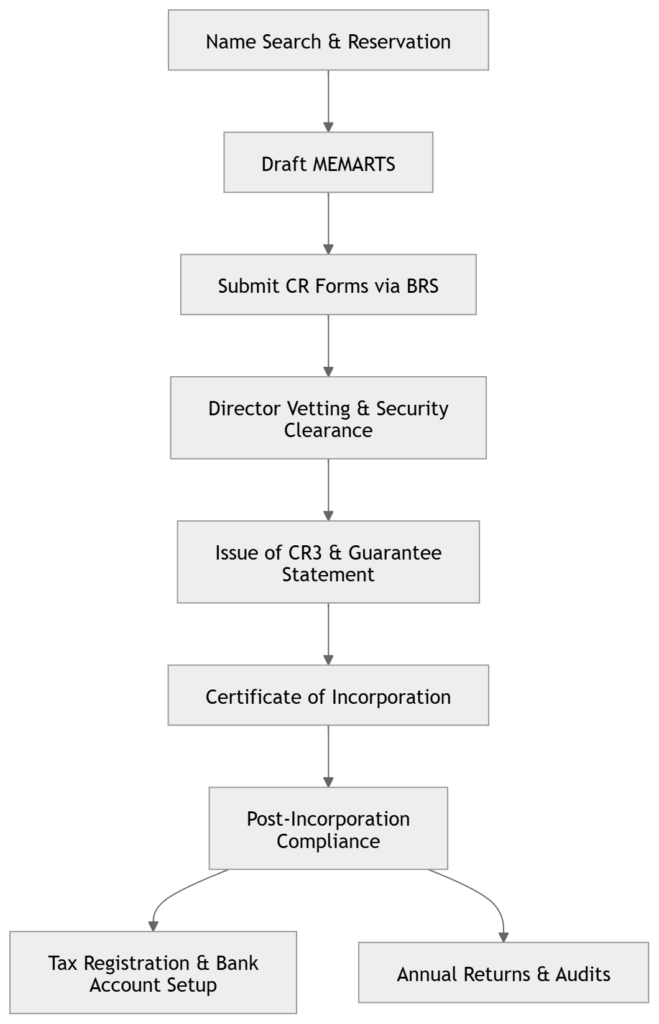
Legal and Structural Workflow Diagram
Key Advantages of Registering a Foundation as a Company Limited by Guarantee
We consistently recommend this structure due to its strategic advantages:
- Strong legal identity for fundraising and partnerships
- High credibility with donors and international agencies
- Simplified governance compared to trust structures
- Flexibility in managing projects across multiple sectors
- Clear asset protection and non-profit enforcement mechanisms
FAQ: How To Register a Foundation in Kenya
1. What is the best legal structure for a foundation in Kenya?
Most foundations register as a Company Limited by Guarantee (CLG) under the Companies Act, 2015 because it is efficient and widely accepted for non-profits.
2. What are the main steps to register a foundation?
- Name search and reservation at BRS
- Drafting MEMARTS (constitution)
- Filing CR forms (CR1, CR2, CR7, CR8)
- Director vetting and approval
- Issuance of Certificate of Incorporation
3. How long does registration take?
Typically 45–60 days, depending on vetting and document approval timelines.
4. Can a foundation apply for tax exemption?
Yes. After incorporation, you can register for a PIN and apply for tax exemption with KRA.
How AWK Advocates Can Help
At AWK Advocates, we provide comprehensive, end-to-end legal support on how to register a foundation in Kenya, ensuring that every stage of the process is handled professionally, accurately, and in full compliance with the Companies Act and Business Registration Service (BRS) requirements.
We begin with name reservation and legal clearance, where we carefully conduct name searches and secure approval for your preferred foundation name to avoid rejection or delays. We then proceed to drafting MEMARTS and compliance documents, ensuring that your foundation’s objectives, governance structure, and non-profit clauses are properly drafted to meet legal standards and support future funding opportunities [1].
Our team also handles filing all BRS incorporation forms correctly, including CR1, CR2, CR7, and CR8, ensuring accuracy to prevent processing errors. We manage director documentation and vetting processes, ensuring all identity, tax, and compliance details are properly prepared for approval.
Beyond incorporation, we guide clients through tax registration and exemption applications, helping foundations qualify for tax benefits where applicable. We also assist with opening bank accounts and post-incorporation compliance, including annual returns and ongoing regulatory obligations.
With AWK Advocates, we ensure your foundation is not only registered efficiently but is also fully compliant, structurally sound, and ready for donor funding, partnerships, and long-term operational success without unnecessary delays or legal complications.
How To Register A Foundation in Kenya
The registration of a charitable foundation in Kenya as a Company Limited by Guarantee provides a robust legal framework for individuals and organizations seeking to create meaningful social impact. By following the structured BRS process—from name reservation to incorporation and post-registration compliance—foundations gain full legal recognition, operational stability, and enhanced credibility.
With proper documentation, compliance discipline, and governance structures, a charitable foundation can operate efficiently, attract funding, and sustain long-term impact within Kenya’s legal framework.